
When reality at the bottom looks like failure from the top
The new strategy was launched six months ago with a CEO roadshow and big A2 posters in the break room. But already, Executives bring reports of delays; the outputs planned for the end of year one are already looking like they’ll land half-way through year two. From the Exec team’s viewpoint, this is difficult to interpret.
In the middle of the org chart, the managers feel it’s all very familiar.
Up at Exec, the usual corrective actions get suggested. Managers need to be reminded about priorities; accountability needs to be reinforced. Perhaps people should come into Executive and explain the delays. Someone suggests ‘maybe we have the wrong managers?’
This is the wrong diagnosis and the wrong corrective action. At this point, Exec need to ensure they are accounting for the reality of the Operational and Continuous layers. (If the Stack is new to you, the first article in this series gives the overview.)
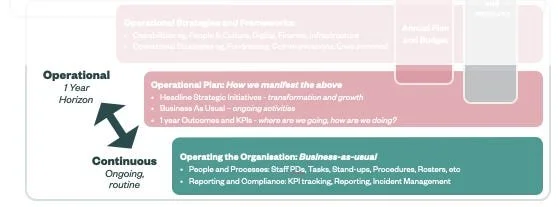
The Operational Plan contains two distinct types of activities:
Headline Strategic Initiatives – transformation and growth
Business As Usual – ongoing activities
The first of these is where Exec are focused, because this is the primary work of their Layer. But deeper down, the BAU work is occupying 90% of the effort. The Initiatives don’t fit in the remaining 10% and from the Continuous layer’s point of view, the front line of work will always come first. “I didn’t run payroll because there was a workshop about the ERP implementation” is a sentence that’s never been spoken aloud.
Also, the continuous layer is often still dealing with implementation of items that Exec and the Board think are finished – the tail end of the last cycle’s strategic initiatives. There’s no space for the Continuous layer to accommodate these new initiatives, and when Jeff’s focused on his weekly sales target, he has little incentive to worry about a three-year project.
This isn’t any individual’s fault, and it isn’t resistance to new work; it a problem of incentives, visibility and rhythm between layers with different functions and priorities.
This problem was 12 months in the making, and is predictable. Many “Strategic Plans” do not contain or acknowledge BAU, but just assume that absorption will happen. The solution won’t come from more communication, but from building the visibility and communication between these layers.
Solutions
The solution lies in fixing the systems that communicate across the layers in the Stack. Specifically, integrate BAU and Strategic Initiatives into the same tracking systems, and give them ownership and visibility. Working with a community services organisation, I built a plan with the executive and middle management layer that explicitly mapped BAU functions alongside the strategic initiatives. Each area of activity had two elements. There were clear BAU tasks with owners and targets, with an updateable section for a RAG assessment and corrective actions. And underneath, activities against each Strategic initiative, sequenced with owners, also with a RAG and corrective action area.
In the Management layers, the impact was a framing of the sequencing and tradeoffs that spanned Initiatives and BAU. Activity conversations became honest, were driven by insight, and made real-time adjustments – specifically, one initiative was delayed by a quarter to allow a previous initiative to fully bed down into BAU.
For the Board, the RAG and corrective actions were pulled together for a clear dashboard report across 2 A4 pages. The information flowed from the front line to the top of the Stack.
Close
Two things happen when the connection between the Operational and Continuous layers is improved. Managers and staff doing the work get a system that sees them clearly -- their BAU load, their capacity, their actual progress. That is a valid outcome in itself: people work better when the system reflects the entire picture.
There’s also a longer-term impact elsewhere in the Stack. A Board that spends a few years reading a dashboard that integrates BAU and Initiatives starts thinking differently; the strategy they develop in year three looks nothing like the one on those A2 posters -- because it was built with a deeper and broader sense of the organisation. Fix one part of the machine, and over time you improve the whole.
This is what the gap looks like at the base of the organisation. In future articles I’ll look at what it looks like from the top of the stack -- and why the strategy itself is sometimes part of the problem.
First published in Strategy, Applied.
