
The map most boards are missing (or, the conversations no-one is having)
Most board and CEO frustrations stem from not having a shared map of how the elements in the organisation connect. Over the past year as I’ve worked inside and outside organisations, across Board, CEO, coaching and consulting one thing stands out – the structure of the system is simply not legible to people.
I watched a workshop get stuck. The CEO was frustrated: the strategy is crystal clear, and delivery is underway. But Directors pushed back: the strategy is unresolved and unclear.
But they weren’t actually disagreeing. They were talking about two completely different things:
CEO: ‘We are delivering this year's contracts, and the planning is in place for next year.’
Director: ‘Who will we be serving in 2035?’
Both are right. Both are using the word 'strategy' in a defensible way. But neither framing relates to the other.
Productive ‘Strategy’ or ‘Governance’ conversations require agreeing on a shared meta-reality: hierarchy, connectedness, flow and ownership. Otherwise we discuss up, down and across all at once - like talking ingredients, dishes, menus, restaurants and then even whether we are hungry anyway, all while sitting in the restaurant.
I couldn’t find this meta-reality, this mental model of how all the system fits together and flows over time. So last year I built a map that I’ve since used with leaders at all levels; it always resonates, always prompts an insight and always yields a sigh of relief: ‘I see that now.’
So here it is.
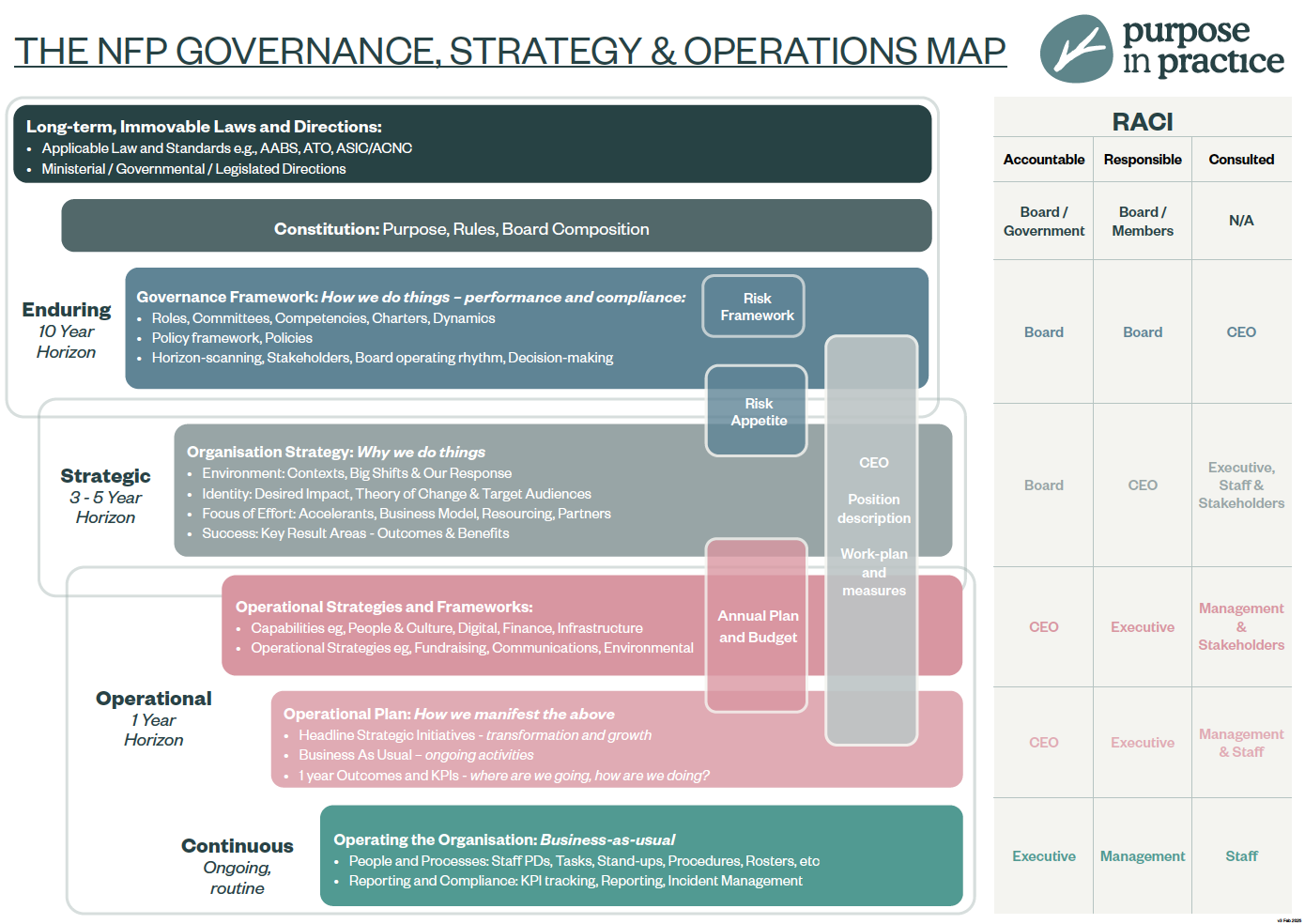
The NFP Map (PDF) shows how organisational elements relate to each other and flow with distinct rhythms.
Enduring (10-year time horizon)
Your largest container is set outside your systems – laws and regulations. Inside that is the outer boundary of your organisation. The Constitution, governance framework and risk framework set the rules of the game; it is the boundaries and permissions that everything else operates within.
Most people in the organisation never touch this level directly, but everything they do is shaped by it. It defines what we are and what we are bound by. When it's healthy, people don't think about it much. When it's broken or absent, nothing else holds together.
Strategic (3-5 year horizon)
This is where the organisation decides why it exists and what it's trying to become. Organisation strategy and the CEO’s position description sit here. When this level is clear, every decision below it gets easier. When it's empty or confused, every decision below it becomes a first-principles debate. This level provides context, direction and identity. It’s also the level where ‘wing it’ is least likely to work.
Operational (1-year horizon)
This is where strategy gets turned into plans, budgets and frameworks for action. It's the translation layer: taking three-to-five-year principles and direction and expressing it as this year's work.
Most of the disagreements between Boards and CEOs happen at this level, often because work at the Strategic level isn’t doing its job. This level provides the machinery of delivery. It answers: what are we actually doing this year, with what resources, measured how? Operational frameworks, budget, and corporate plans live here, though planning and budgets stretch up and down the levels.
Continuous (ongoing)
This is where the organisation actually lives. Staff PDs, procedures, reporting, daily decision-making. When you walk around the building, this is what you see. It's also the level most invisible to the board, and the level where problems from above finally show up as real pain. This level provides the organisation's actual capacity to do its work. When the levels above are aligned, this level just works. When they're not, this is where people burn out compensating for structural confusion they can't name.
Risk
The stack shows Risk Framework at Enduring, and Risk Appetite bridging into Strategic. The framework is how – imagine it as looking upwards, defining how we meet obligations to Constitution and the law. The appetite is part of the framing of strategy – what risks will we take in service of our purpose, and what risks won’t we take?
CEO
The CEO spans the organisation. Management layers also cross multiple levels, but the CEO is the one role that touches all four horizons. If the Board builds the machine up at Enduring and Strategic, it is the CEO who drives it across the system. It’s why recruiting a CEO is probably the most important activity a Board undertakes.
Culture
Why isn’t there a box for ‘culture’? Because it’s all culture – ‘the way we do things here’. Writing a document is culture, obeying a regulation is culture. If this is a map, then culture is the terrain – the reality of everything that’s experienced.
RACI
The map also relates these to accountability as a RACI showing who is accountable, responsible, consulted and informed at each level. This matters because confusion about ownership and responsibility is often a root cause of dysfunction.
There’s a clear hierarchy here. Accountability for existential issues – Governance and Strategic – sit with the Board. Accountability that the organisation works sits with the CEO. The Board’s influence on the layers below is through the CEO. Notice also that at the Continuous level, it is the Executive that holds the accountability, not the CEO.
There are lots of writings and resources about the difficulties that show up inside any given level (how should a board operate itself? What is the right environmental strategy?). However, what this map seeks to reveal is that the true challenges lie in:
Finding harmony and resonance between the different rhythms at different levels
The distance from top to bottom, and the impossibility of any human spanning them
How legible each layer is to the others – and how communication methods help or hinder
Understanding – and agreeing – how the RACI matrix applies at different levels
Accurate diagnosis of problems that have cascade or multiplying impacts through the stack
Designing solutions at the right level – which is not always at the source of the problem
Recognising and adapting to external reality as it impacts at multiple levels, at different times, with different force, with different legibility
I don’t suggest that this is the One Map To Rule Them All. I do suggest that this map has deep utility in orienting people to the reality of an organisation and giving language for diagnosis and solution.
Over 2026, I’m going to use this newsletter to apply this map as a lens to some real world scenarios that are showing up for me and my clients - patterns you might recognise in your own organisation. I’ll keep revising the map based on feedback and experience. And next time you see two people lost between two incompatible positions, ask them if they’re reading the same map.
