
On viewing Zhao's masterpiece: consultant as filmmaker
Consultant-as-content-expert is a dying model. Over the summer, I reflected that now i’d go further - consulting as primarily rational work is over. It’s not solely the application of logic and empirical data, which tends toward powerpoint theatre that can’t be meaningfully executed
For me, consulting is an embodied experience. But bald factual descriptions of this embodiment - working together in safety, coaxing meaning and clarity from groups, stewarding decisive action - feel too much like wishy-washy-AI-sloppy to be useful. And i find those sales-course three-element illustrations (Context-design-results!) even more disappointing in conveying the richness. Perhaps metaphor can get closer?
Chloe Zhao’s Hamnet is an astonishing film (Guardian’s 5* review). I urge you to stop reading this and go and see it.
Welcome back. Leaving aside so much of the brilliance, there was a remarkable moment of cinematography that is burned into my eyeballs, partly because it expresses genuine consultation. It isn’t a famous still, and i refuse to demean Zhao’s creation by trying to recreate it with AI, so I sketched it for you.
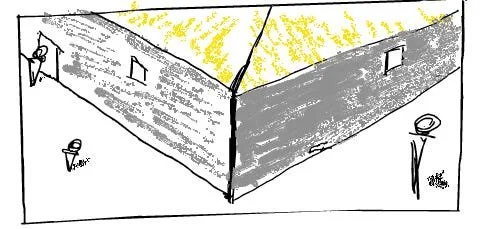
high wide angle shot from Hamnet
Shakespeare has said goodbye to his son. They have lingered at the corner of the building and finally parted. The boy is walking back to his mum, the father is walking to his carriage back to London. Inside the film, they can no longer see each other. We the audience see both, with the corner of the building between them.
As the viewer you feel the common grief yet are simultaneously aware of what’s different. Shakespeare wants his art, the boy wants consolation in his mother’s arms. The film holds this moment of complexity and shows un-cohesion.
At the end, every human in the scene is gesturing and facing in one direction. Their faces (attention, intellect, emotions) and their hands (action) are all unified. The film pulls us, the audience, into this common experience with the protagonists, together at last from two hours of repeated isolation and misalignment.
Why am I raving about these scenes? How the camera positioning creates the audience’s perspective.
In the separation scene, the camera is high and wide-angled. It sees both characters at once, equal, making no judgement about them. It shows us the audience what they can’t each see from their perspective. This is a role of the outsider consultant.
At the end, the camera cuts from a high wide shot - inside a circular theatre, not an obliquely angled house - to the protagonist’s point of view. We see her view from within the crowd, looking at the journey onward that forms the conclusion and ultimate emotional heart and purpose of the film. This is the role of the insider consultant.
How do i find this metaphor useful? Last year, running a Board strategy workshop, I faced a moment where one Director had a diametrically opposed view to all the others. They expressed it hesitantly, then invited its dismissal with a hedging ‘maybe i’ve misunderstood the discussion and i’m wrong’. I took the high wide-angle moment, stated clearly that yes it was indeed a very different view. Acknowledged the corner between them.
I then asked the room if we followed their path instead, where might it lead us? Two directors repeated their point of view - they were staying on other side of the building’s corner. Not wrong, just different. Then one Director answered my question with another question back to the original outlier: where do you think this could lead us? And in their answer, the wall began to dissolve.
I asked the room, can anyone see a way that these different views show us a best option forward? and one of the quieter directors stepped in and spoke for about ten seconds, and there it was - the new direction. And as I wrote it on the whiteboard, and invited them to read it back, sit with it and think whether it worked for them, i felt the room melt into unity. Done.
Fin
Zhao knows how to alter the perspective - outsider to insider, alone to together - in a way that feels like how i’m working to work.
Working this way means shaping the views that the participants have of themselves and their collective thinking, in the moment: widening the lens, tightening it, cutting the shot, or letting it extend.
My central point is that this is not driven by rationality. All facilitators have frameworks, like any filmmaker can storyboard up a suite of close-ups, two-shots, pans and zooms.
But moving beyond rational consultant-as-expert logic allows me to work intuitively and creatively, which gets far better outcomes than a logically defensible agenda.
First published in Strategy, Applied.
