
'What's the solution?' is the last question you should ask
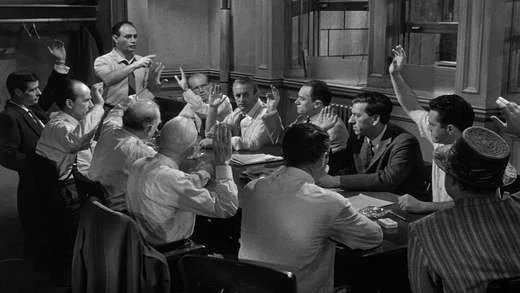
12 Angry Men - one of my favourite films
I worked with 14 Board and Exec teams in strategy workshops last year. In around half of them, someone was a little disruptive. You learn pretty quick to deal with phone checking and side conversations. But there’s a category of disruption that’s more problematic and doesn’t get enough attention amongst facilitators: thought-terminating cliches. When they appear, collective thinking stops almost instantly.
Over the summer, going over my post-session reflections, I realised there were three types - two simple and one far more insidious.
Thought-terminating cliches type 1: despair
it is what it is!
there’s no point, Steve will do what he wants anyway
we tried tackling this last year, it didn’t work
This is an invitation to find allyship in despair, and relieve a fear of failure by feeling it together.
To move the group past it you must first acknowledge those feelings are real - they’ll only move on if they feel heard. Then you can remind the group that we are here now, we are all good thinkers, and collective thinking is powerful. The key is to focus on action, not passivity. Ask,
What if Steve would welcome alternatives?
Could we come up with better ideas / evidence / analysis?
What did we learn from the last attempt that we could apply this time?
Last year I faced a Board that was pulled into despair by a weary we’ve talked about this so many times, we never get anywhere. I acknowledged we might not get anywhere this time either, but could they indulge me for just one minute to try? I asked them to think of ten possible options. The energy created by the deadline led the group to find a new path - after laughing at the ridiculousness of the first two (‘Burn our CRM and start again’, ‘Don’t even have a website!’)
Thought-terminating cliches type 2: certainty
this issue is just too expensive to fix
the Board won’t agree
With these two, someone is asserting a fact, not a feeling. This is a claim to knowledge, and it is often true. The important point to emphasise in this moment is that while it may be true, it isn’t useful to the task at hand. There will always be a thought-terminating fact at the early stages of exploration.
It is usually better to avoid arguing with the fact head on. Magic it away, ignore it, or reframe it into a smaller obstacle. The person who’s said it has more power to deploy these facts than you do. Instead,
Let’s assume a miracle: money can be found / the Board will agree. What might that mean for us?
I agree that’s a big obstacle. Can we stick with it a bit longer; we might discover something (how expensive? / why the Board won’t agree?)
I agree that’s a scary number - we could look at it as 10% of your P/L over three years; perhaps we might we explore if it’s worth that?
Even a cautious Board might agree to take a risk if we could show real benefit - could we explore those?
Thought-terminating cliches type 3: Demanding a solution
This was my revelation last year - the most insidious shut down of open thinking.
OK then, what’s your solution?
So we should sack Jeff?
This is difficult because it looks constructive; ultimately finding a solution to our problem is what we want.
But this thought-terminating cliche has two specific impacts that the others do not. Firstly it flattens any complexity underlying the problem. Any deeper issues are masked by the demand to solve the simple surface presentation. This will always result in boomerang problems: didn’t we fix this last month?
Secondly it has a dramatic impact on the person trying to name the problem. It suggests that without having a solution, naming the problem is foolish or unhelpful. This leads to a group dynamic where no-one will raise an issue without having thought of a solution first, defeating the point of holding a discussion.
At worst, this cliche suggests that if the person raising the problem does not have a solution, then there isn’t really a problem is there? (And we can circle back to ‘it is what it is’!) A moment's thought shows this is ridiculous - you don’t have to plan a cafe reservation in order to state ‘i am hungry’.
Why do people do this? Sometimes it’s personal style - action-oriented people will want to hurry along. Sometimes it’s time pressure - when there are multiple items on the agenda, sitting in the problem for so long feels indulgent. But it’s important to name that sometimes it’s a power move: domain experts sometimes assert control over the discussion. An academic or an accountant, or a third-term Director, might shut down a consumer insight manager or a new Director this way.
Last year I learnt some better ways to shut this down. Firstly, the pre-work. I often carry out a survey before a Board workshop, where each Director can speak freely and anonymously. This enables me to raise problems with the complexity of the problem baked in. With one Board last year, different directors raised three separate concerns: falling staff retention rate, project delivery delays and underspends in capital budgets. Raising these three together led directors to inquire whether they were sequencing their strategic initiatives correctly and adjust.
Secondly, in the agenda and introductions: ‘Before morning tea, we’ll explore problems. After tea, we’ll break into groups and look at solutions. If you have thoughts about solutions, make a note and we’ll come to them at 11.00.’
And lastly, in the moment, being courageous as a facilitator to step in front of the solution-demander and pull focus back to the problem-spotter. I’ll ask them to speak at greater length about what they’ve seen, or invite others in the room to contribute to describing the problem.
Facilitate like Henry Fonda
In 12 Angry Men, Fonda’s character models problem exploration: he refuses to rush to a verdict. While his fellow jurors want to convict and go home, he insists they examine every piece of testimony. By refusing to accept that the problem is as simple as initially presented, he forces the group towards a deeper understanding. Only with a shared understanding of the evidence can they vote.
That's what a facilitator must do: protect the space for problem exploration before the group moves to solutions.
First published in Strategy, Applied.
