
Organisation stuck? Wiggle your elbow
Fresh off my chemistry degree, in the second lecture of my communications Masters, the fabulous media studies professor got us standing in a five by five grid in the middle of the room. Instructions to the front row – sit down, move your heads about. Second row, kneel and follow the head in front of you with your wrists. Third row, keep your left elbow pointed at a right wrist in front of you. Eventually 25 of us were wiggling about. We were faithfully following our instructions, but no-one knew what was actually going on.
Augusto Boal’s Theatre of the Oppressed did this with actors to demonstrate power and mediation. Our professor was removing our scientific straitjackets and throwing us into the deep waters of critical theory.
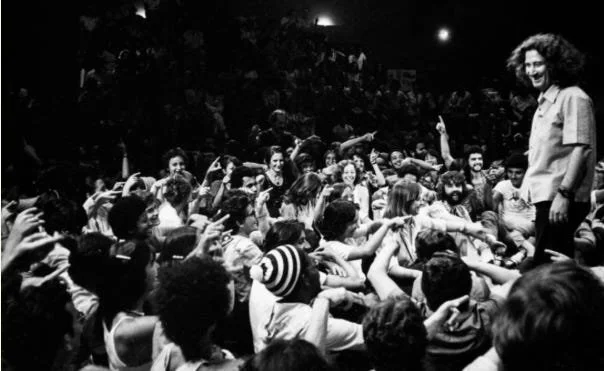
Boal working with students in his Theatre of the Oppressed
I keep coming back to it 31 years later; work is often illegible from inside the system. Every human in the system responds to what reaches them, and what reaches them has already been translated, filtered and reframed through every layer and across every silo. The back row is not failing to understand. The system is undescribed.
What the Stack does
That is the gap the NFP Stack addresses. Not the complexity itself — organisations are genuinely complex, and no framework makes them simple — but the legibility. A shared map of how the layers connect, what each one is doing, and who carries accountability at each horizon gives people something they rarely have: a way to see the system they are inside.
In Boal’s exercise, when the back row is asked what’s happening they don’t know. When I did it, I felt confused, ignorant and unskilled, despite being one of the 25 clever graduates in the room. But that feeling wasn’t fact – it was a consequence of an unclear system.
To reduce the confusion, the solution isn’t to make the people ‘cleverer’ – it’s to give them a map of the terrain. The Stack makes visible that they are responding to a relay, and the relay is the issue. Problems are system failures.
I often hear leaders suggest that removing blame is necessary because only then do people embrace failure, learn, grow and so on. I believe it’s deeper than that – blame is simply inaccurate. 22 year old me wiggling his elbow in a circle wasn’t to blame for anything, just an actor in a silly system.
The Stack does three things well: it makes the system visible, it gives people language that does not threaten anyone, and it locates dysfunction at its actual source rather than on the nearest available person. That is the scope of it.
What the Stack cannot do
I promised in my last article to write about information flowing upward without fear or favour. Hierarchy creates pressure. An executive who knows staff morale is poor will often soften that into neutral language before it reaches the board because the system creates incentives to project confidence upward. A board that reacts badly to bad news will stop receiving it. By the time the signal arrives at the top, it has been managed.
The Stack can show you exactly where that is happening. It can name the gap: the signal is being filtered at the Operational-to-Strategic boundary, the board’s receivability is low, the hierarchy is doing what hierarchies do. Closing the gap first requires patience and trust, to accurately diagnose. Then it needs a decision to act differently.
The tool is not the point
A carpenter’s value is not their tools. It is their judgement about what the job needs, and the craft built from years of reading situations and responding well. You wouldn’t hire carpenter who owned one tool.
The Stack is just one way to read what is going on in an organisation. It is a diagnostic language, useful when you need to make the system visible and give people a non-threatening way to talk about it. There are other tools, other lenses, other ways in. What matters is the capacity to assess what is actually needed and respond to that, not to the framework itself. The people are the work.
When the rules run out
I have been teaching daughter 2 to drive. One situation frustrates her: two cars facing each other, both turning right, who goes first? The rule “If two cars facing each other are both turning right, the one who arrived first has right of way” is unclear. What if they arrive at the same time?
The answer is to trust the human. Look at the other driver, use eye contact and gesture to take or cede control. Systems and rules are only a map, not the terrain.
That is the edge of every framework: the map gives way and the people in the room must look at each other and communicate clearly enough to act.
First published in Strategy, Applied.
