
Great Boards act slow
Twenty years ago, leading the Public Offer for a new museum build, I had a Steering Group to oversee me and my team. The build included research facilities, so there was a Science Project Director, Mike, and Steering Group (SG) as well. I sat on the Science SG, Mike sat on mine.
The Public Offer SG was great. Every meeting, we took decisions. I left with actions authorised. Progress! The Science SG was a nightmare of faff, deferrals, re-analysis and demands for greater consultation, with maybe one meeting in three reaching an actionable decision where AT LAST Mike could get going.
About nine months in, I realised I was wrong. The Science SG decisions would stick as the project moved forwards. My group’s decisions would unwind: an unexpected consequence, or a new stakeholder view, would lead us to re-prosecute the issue again. And again.
Without naming specific Boards, I’ve seen this governance pattern over and over. Twenty years after first seeing it, I’ve come to see intentional tempo as a defining feature of effective Governance.
Making sense of tempo with the NFP Stack
The Stack (if it’s new to you, peruse the intro article) shows clearly the cadence at which different levels operate.
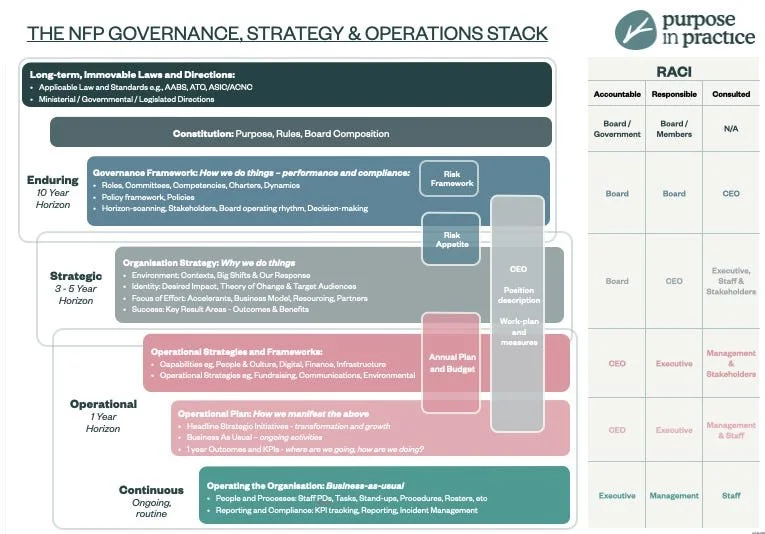
Tempo is structural. As financial authority increases with each layer (a manager approves a few hundred dollars, the Board approves millions) the clock speed decreases. The Board’s six-weekly rhythm matches the horizon at which governance decisions operate: three to five years out. It shouldn’t be urgent like a fire alarm, it should be deliberate like making a building fireproof.
The gap in tempo between a Board and its operational layers is a feature, not a fault. The boundaries between layers should always feel mismatched in speed.
Where it goes wrong
There are two drivers to the problem. One is the Board responding directly to an operational team arguing for speed. The other is when the Board senses changes in their strategic context but fails to triage; while some issues need a crisis response, most do not. Either way, rushing creates poor decisions and misalignment between Board members - the range of possible options narrows before all the insights are on the table. For the Executive, the signals arriving from above become confused and contradictory, leading to confusion for front line staff.
The faster the Board moves, the more it has to revisit. Speed creates its own backlog.
What to do?
First off, the system needs to be built so that operational layers can work with the speed they need. When I worked at the cemetery, there were specific resources and processes in place to facilitate Islamic and Jewish burials by sundown the following day. A referral upwards to permit increasing staff or undertake Sunday operations could not be a requirement.
That’s intra-level speed. Sometimes when urgency keeps flowing upwards it is because the operational system is not built to handle the tempo, and that is a problem the Board need to oversee the CEO to fix.
But when handing things up and down the levels, there is a paradox: the Board’s greatest power lies in slowing down. The friction this creates is valuable. Just like it resists being bounced into a poor contract, so it must resist bouncing into a hasty decision: done now is the enemy of done properly. Usually this will frustrate the Executive. But ‘do not frustrate the Executive’ is not a Board KPI. Slowing down is a useful exertion of valid power: ‘we need these issues analysed before approval’ is good feedback to the staff and produces improvements in what gets escalated and how, in the future.
It is better to disappoint your operational teams by slowing down than to enter their world by speeding up.
In practice?
It’s wise to start with asking a deliberative question: is this actually urgent, or is it just being communicated with urgency? Then, ask Executive to describe clearly what problem needs solving and the impact of not solving it today - then triage accordingly. (‘We’ll lose this contract’ is a small issue if there are fifteen others to win, but a genuine crisis if it’s the only revenue on the table.)
The Chair can use a specific tool: hold two ‘thinking rounds’. Firstly, they can ask each Director to reflect then describe what they see as the most important aspects to address. Once everyone has spoken, ask directors to reflect on what they have heard and then state what action the Board should request of the CEO. After these, the room will have calmed, discussion will be focused on governance, and everyone will be directed towards actions for the Executive, keeping the Board in governance, not executive, mode.
The exception
Sometimes there is a crisis and the Board must accelerate to the rate of operations. COVID remains the exemplar of this, when Boards were meeting weekly or even daily. But crisis must be exited, and part of business continuity is to slow the board back down again. Calm the cadence, deliver long-term value.
Up next
A board that holds its tempo to the speed of governance creates the conditions for stronger leadership. But directors also require high quality insight - which needs the system set up for information to flow upwards without fear or favour. That's next bi-week’s newsletter.
First published in Strategy, Applied.
