
‘I don’t want to argue about whose dad has the toughest strategy’
In 2011, I was working at the National Museum of Science and Industry in the UK. The head of digital cut through the nonsensical mess of ‘Strategies’ by saying I don’t want to argue about whose dad has the toughest strategy and we got something done. This was rare.
Comprising three museums, the organisational chart contained three museum directors AND directors of each of Learning, Commercial, Facilities, Corporate Services and Fundraising. Most of these departments had their own ‘Strategy’ – a Learning Strategy, a Fundraising Strategy, an Operations Strategy, a Facilities Strategy – and each museum had a Collections and an Exhibitions Strategy.

NMSI Collections at the Hawking Centre - if strategies outnumber the collections, a museum is really in trouble!
The overall organisational strategy was practically non-existent. It made bland statements about inspiring audiences, prudence in collections management, financial rectitude – but nothing as sharp as a machete to hack through the jungle of tangled strategies one layer underneath.
So successful leaders employed specific tactics:
Small-target ambition – this little thing doesn’t offend your strategy so leave me alone to do it
Beige compromise – this project ticks off a soupçon of everyone else’s strategy
Alliance-based power moves – directors 1, 2 and 3 agree, and so their lieutenants can tsunami over everyone else
Leverage an external force – a funder appears, an Opinion Former critiques something
It didn’t work; the system was a bloated monstrosity. In the end a Strongman was hired for some my-way-or-the-highway direction, which created clarity, at least.
I’d arrived there from an organisation that (mostly) successfully prioritised a major project at the macro level. So I thought that only this weird organisation would behave like this. Then I found it again at Museums Victoria. A leadership team of 22 contained multiple overlapping and contradictory ‘strategies’ with a sugar-free Strategy over the top that ruled nothing out.
The immediate diagnosis
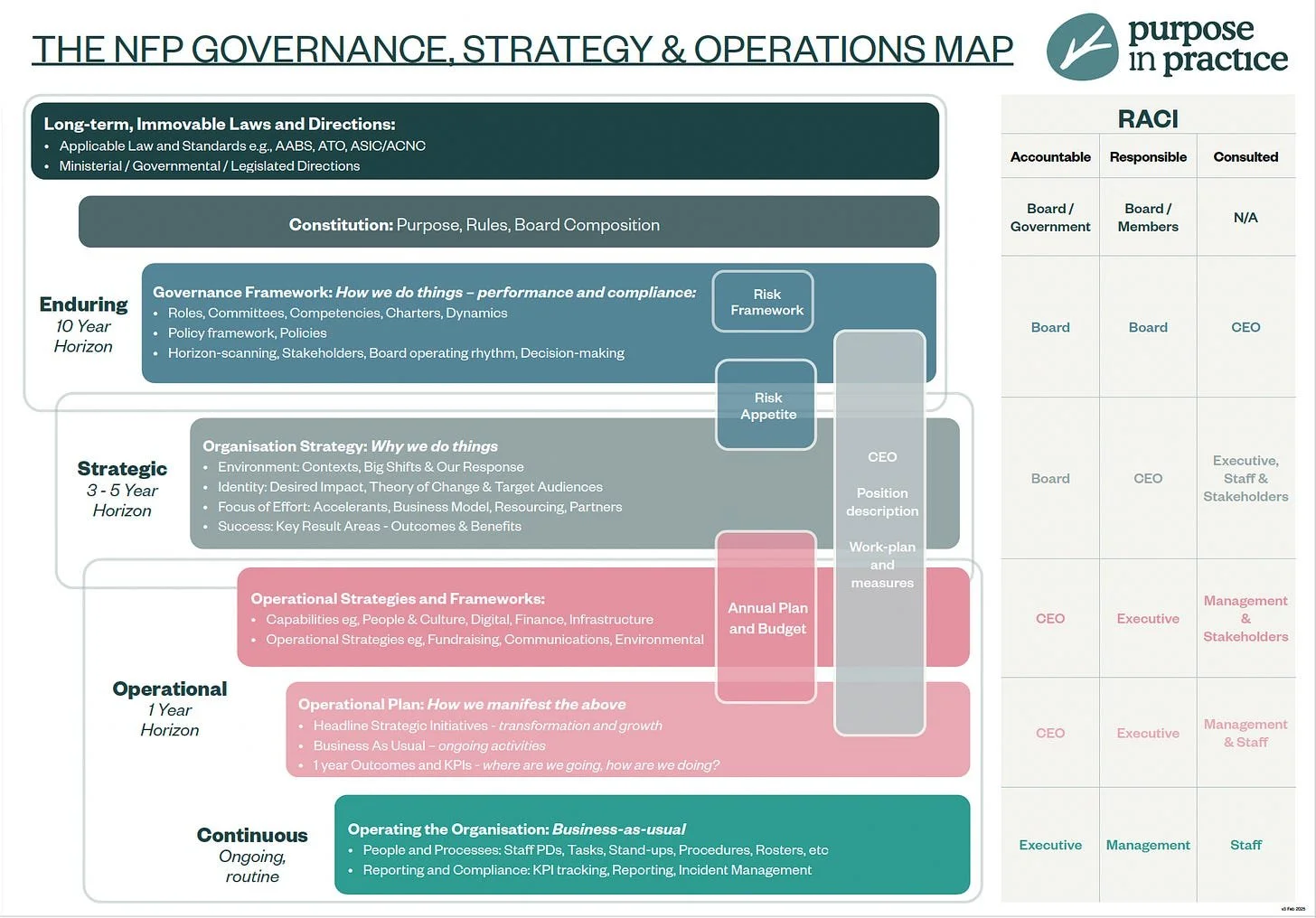
The Stack explains the two things that are happening. (If the Stack is new to you, the first article in this series gives the overview.)
First, the Strategy layer is weak. This layer must be clear; it must discriminate between priorities and rule things out. It must offer goals with measures. (of course, it’s weak because the governance layer above it has not done its job of ensuring it is strong.)
The secondary impact is to make the Operational layer pick up the slack. Directors and senior leaders have spotted the vacuum, recognised their powerlessness to make sense from the layer above, and created local clarity. These ‘strategies’ are usually good: internally coherent, measurable, even inspirational. But though I love a roast chicken, a walk in the rain, and a good novel, I don’t try to do all three at the same time, and I don’t pretend that they automatically add up to a great afternoon.
Why the vacuum persists
If the structural problem is visible, why does it persist? Why doesn’t someone just fix the Strategy layer?
I’ve written before about the over-extension of the word ‘strategic’. It has become a status marker; no-one ever suggests they or their work are unstrategic.
Marketing is sparkling wine but Strategic Marketing is champagne. There’s great prosecco and bad champagne, but champagne does sound better, right?
It’s also a career marker. When a Director left NMSI, they could rightly claim to have ‘led strategy’ – that sounds much more employable than ‘led implementation of parts of the organisational strategy’.
For these reasons, the bloat continued: everyone at the Executive layer under the CEO had a plausible, reasonable personal interest in holding their own departmental strategy. And every middle manager could plough on with their slice of the work, sure in the knowledge that they were Strategic.
No-one is acting in bad faith. In their part of the system, it was reasonable. But the collective effect on the entire system was that the vacuum at the Strategic layer got papered over rather than filled. Fixing it requires someone to explicitly demote a set of documents that people have built their identities around.
What needed to happen
What the Strongman did on arrival was ruthlessly decide which ‘strategy’ would be first amongst equals on a given topic or situation. Within the first six months, that created immediate clarity – people knew where they stood. But it was a person doing the job that a collective understanding (backed up by a document called ‘Strategy’) should have be doing.
Over the next two years an actual organisational Strategy layer was built to enable clarity, without requiring the Strongman to referee every decision. By the end, the clarity wasn’t his – it belonged to the organisation.
How do you spot it in your organisation
You hear that a decision was based on ‘the [department] strategy’
Two department heads are arguing about whose dad has the toughest strategy
Using non-strategy documents as the only reference in decision-making – ‘the approved budget says…’
What to do about it
Strengthen the overall organisational strategy; make it crystal clear. Strengthen the processes of reviewing activity against it. The test is not whether a few department heads like a proposal; it is whether the proposal delivers within the overall strategy.
Kill all departmental strategies – or, if that’s too much, force every one of them to carry an explicit tie-back on page two: how does this sit inside the actual Strategy?
Build an organisational culture around alignment to the one strategy. Every leader should behave like the apocryphal NASA floor sweeper who said his job was ‘to put a man on the moon’: this piece of work right here delivers towards the organisational purpose.
Conclusion
The balance of elements in the Stack is important - if the system is unbalanced, decisions will flow to where they are most usefully made, at the moment they are required. This example of a weakness at Strategic leading to an over-weighting at the top of Operational is one of many ways the system can drift away from optimal functioning.
First published in Strategy, Applied.
