
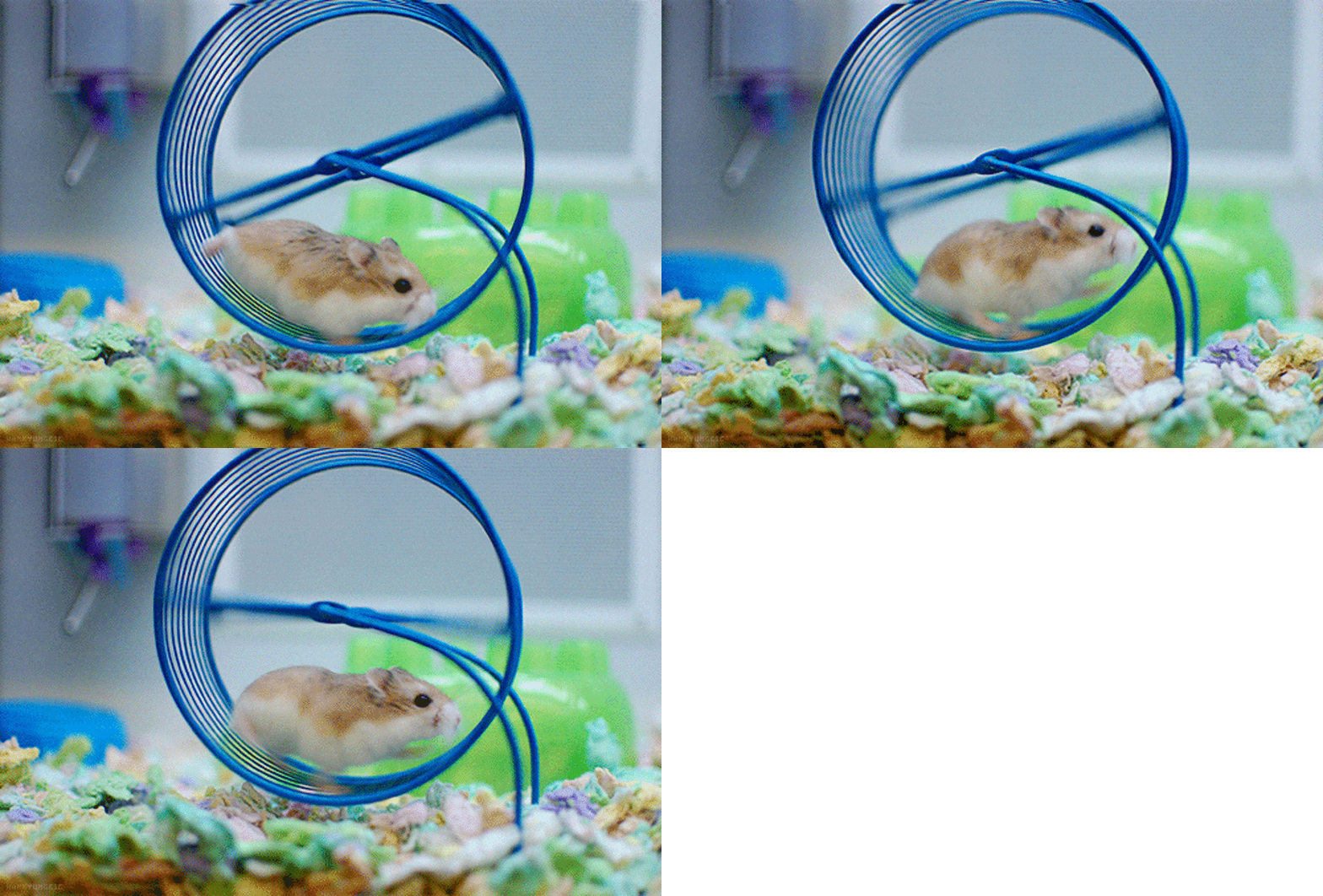
Going nowhere - blame the hamster or the wheel?
The new CEO arrives with buckets of enthusiasm, the Chair welcomes them with coffee, a briefing and a task list. Six months later and both are in feeling disillusioned: all that effort for so little progress.
From the Board’s point of view, there have been few tangible outcomes, despite making introductions, sharing insights and conveying urgency. What is the CEO doing all day?
Are they capable - did we make the wrong appointment?
Meanwhile the CEO is slowly drowning. They’re meeting stakeholders, hearing the Board’s ideas and working dawn to dusk: but the organisation is a *mess*. There’s three people and a manual spreadsheet between the CEO and every data point, operational detail flowing to the top (why oh why did the ex-CEO sign this supply contract?), and the Exec need a referee to discuss any substantive issue.
Have the Board been asleep at the wheel? Why are they demanding instant success when the organisation is in such a low state of readiness?
The observable behaviour is of a Board and CEO stuck in an either/or debate about organisational basics vs impact – unable to move to both/and collective thinking. From there, the perception gap just gets wider, and the Board and CEO begin holding irreconcilable views of the way forward.
I’ve seen the wheels fall fully off the wagon in a couple of different ways:
Board begin to micromanage, mistrust grows and relationships become untenable; CEO exit
CEO begins performative reporting on the Board’s aspirations, while actually focusing on organisational improvement; CEO absorbs the burden into their workload and burns out
Board and CEO collude (sometimes unconsciously) that the Exec are the problem, and that a restructure is the fix. Wastes six months and thousands of dollars, then the new Exec faces the same issues
Board creates a new committee or working group to drive the CEO; in reality it hinders the CEO by adding a reporting burden and the outcomes remain elusive
Blame is seductive. The NFP Stack helps accurate diagnosis and clarifies the levers to pull, and in what order. (If the Stack is new to you, the first article in this series gives the overview.)
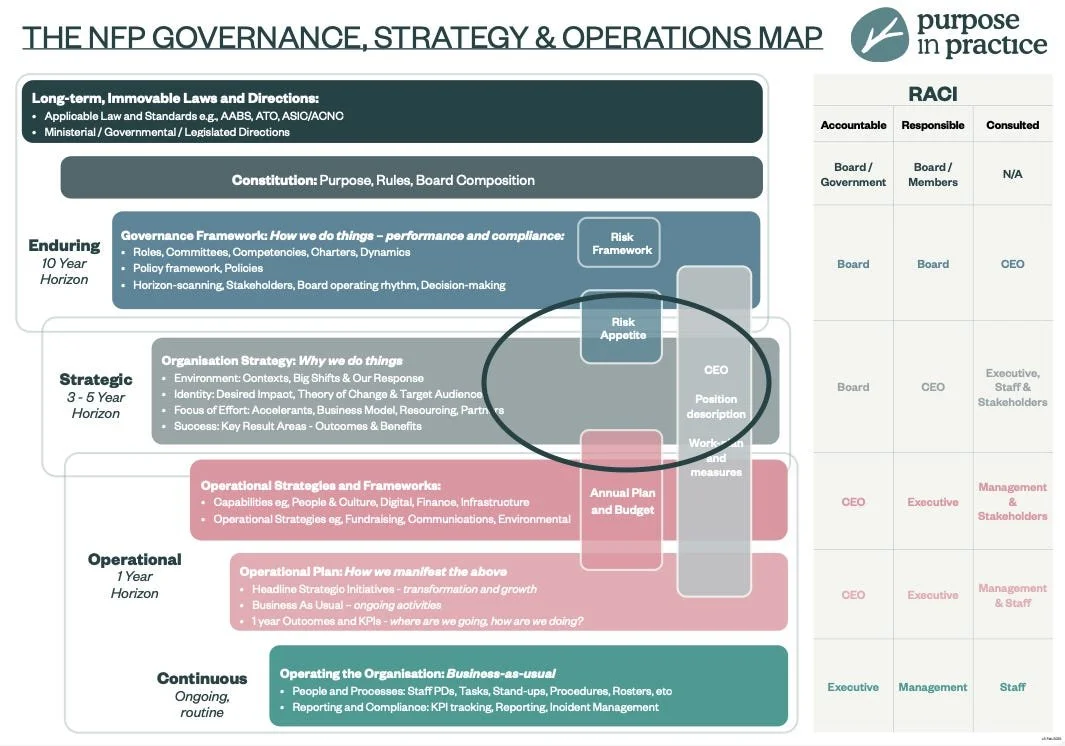
The compounding symptoms I’ve described above can be traced to a single root cause in the NFP Stack – the Strategy layer is not functioning. There are three versions of this failure: the strategy is absent, weak or unused.
For a CEO, and therefore the organisation, to thrive and deliver, the Strategy must create one clear picture of the organisation’s flow over time. This single picture creates the coherence between the five areas of the NFP Stack that interact with Strategy:
The Governance layer knows what decisions are necessary and what must be monitored and measured.
Risk activities can assess what changes in risk and opportunity actions create, and where mitigation is needed.
The Annual Plan and Budget has a clear basis: what to do this year, in what order, with what investment.
In the Operational Layer, Operational Strategies and Frameworks know what must be in place or changed to deliver: capability, brand, infrastructure and so on.
The CEO workplan reflects the organisation’s actual priorities, with measures that match an agreed strategic reality.
That’s what’s needed. Why is it so often not in place? I’ve seen three main reasons (and once even all three!):
Boards and CEOs routinely act outside the strategy document. This is OK – seize that opportunity! – but when the strategy is a once-and-done every five years, drift is inevitable. Update the strategy often (at least every two years).
Organisations produce a “Strategic Plan” – which is actually neither. The separation of true Strategy from planning is essential – strategy by Excel sheet does not work.
Strategy is created as a solely external/future document and does not address the true internal organisational context. (You’ll never achieve ‘Cure Cancer!’ while a dysfunctional Facilities department can’t provide functional laboratories).
Conclusion
A key principle of the stack is to diagnose the root cause, distinguishing it from symptoms. The root cause is Strategy, for which the Board hold accountability. Focusing here, directing the CEO to lead a strategy development process across the organisation and taking the tough decisions necessary to cohere around it as a Board, is the first step.
Fixing the Strategy, then using it to shape the Board’s agenda, the CEO workplan, and ultimately the entire Operational layer is what enables enduring success.
First published in Strategy, Applied.
