
Your AI will never have a mandate
Last newsletter I wrote about how AI cannot be a full solution to strategy development, because it lacks the crucial embodied feeling of a human collective. Today, I’m taking another lens on how adopting AI for strategy development requires an explicit reframing around Board accountability.
Interest in the term ‘Decision Rights’ exploded in August last year:
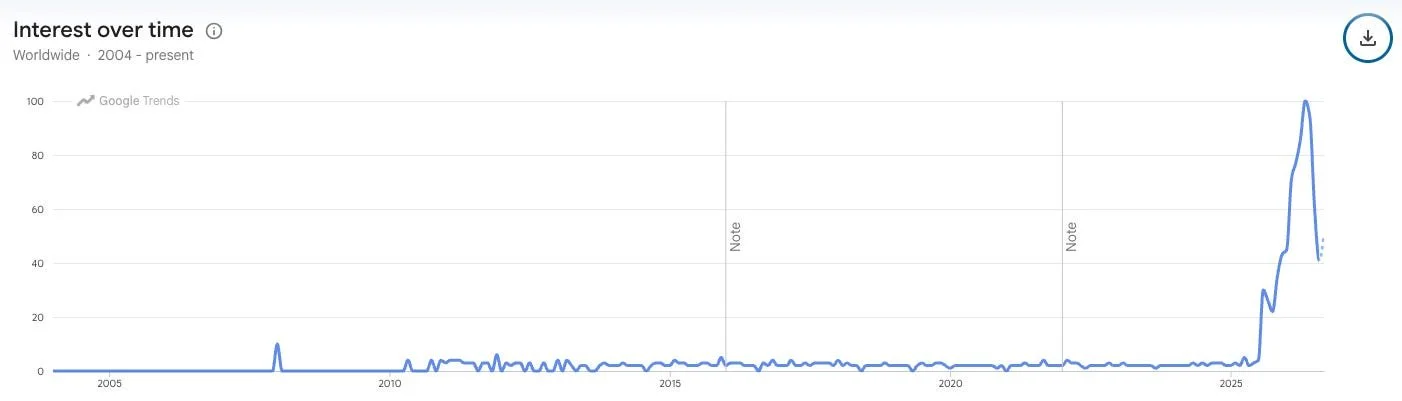
Google Trends, 2004-present, Interest in the term ‘Decision Rights’
It has emerged as a term synonymous with authority in an organisation. I’ve seen who has decision rights on this project? and decision rights should align with expertise not seniority in articles just in the last week. But rights describe what you are allowed to do; there are no obligations associated with rights. I may whistle, but I do not have to. Applying this logic to ‘decision rights’: if all you have are ‘rights’ then you don’t have to do anything. Just defer that approval meeting, let the team drift, so what?
And Harvard Business Review posted this today:
Your company approves an AI system to make decisions. It works. Employees use it. But when the AI and a person disagree, the person still makes the final call. Has the organization actually adopted AI? … employees may still review their outputs, override recommendations, or add approval steps before acting on them… There may be a rational reason: If an employee follows the AI’s decision and it goes wrong, who is held responsible?
As AI takes on more consequential decisions, leaders will have to decide where authority actually sits, and whether accountability needs to move with it.
Note two things. First, the framing around ‘rational’ – that this is an issue that involves only thinking. More importantly, note the treating of authority, responsibility and accountability as broad synonyms.
These two examples highlight that there is a framing in wide circulation (including being promulgated by the largest governance publisher in the world) that elides multiple related ideas and oversimplifies a key concept.
The anchor they are missing is mandate. Something I am charged with doing, that has been granted to me by someone (perhaps members, shareholder, or government). It is mine – I cannot give it away – and if I do not exercise my mandate, I have failed.
Mandate, from the Latin 𝘮𝘢𝘯𝘥𝘢𝘵𝘶𝘮, from 𝘮𝘢𝘯𝘶𝘴 and 𝘥𝘢𝘳𝘦: 'Given into the hand'. It is both granted to the Board and held by the Board, and contains two parallel concepts:
Duty: an action taken in accordance with a mandate; an obligation discharged
Accountability: being answerable to the body that granted the mandate for the exercise of these obligations.
Duty flows outwards (what you do) and accountability flows back to you (consequences).
Illustration. On a Board, I have a mandate to act as a Director. This mandate is described in a Constitution and in law, both constructed outside me, and is awarded by members and government acting on their mandate. I am obliged to be diligent; for example to deliver purpose, avoid insolvency and ensure a safe working environment for staff. Should I fail, accountability will appear, perhaps as prosecution, perhaps at being voted off the Board.
Yesterday my AI tool rewrote part of a document I’d asked it to critique. I was furious with it, but quickly my anger turned on me: Why hadn’t I kept a copy? Why had I asked it at all? I was looking for accountability, and the only place it could go was the nearest human.
The concept of a mandate is foundational to organisational practice
Mandates are woven tightly into organisational assumptions like fishes into water: we don’t step back and name it. A ‘delegation of financial authority’ setting out who can spend what amounts within what constraints is actually a mandate. The CEO is expected to spend money to deliver the strategy. You must notify your manager of a health and safety issue.
Position Descriptions are descriptions of mandates – for every dot point, you can extract obligations and accountabilities, which together make a mandate.
Imagine, for a moment, that you only listed rights in a position description. The CEO may spend money, the CEO may fire people. This is ludicrous. It is only the existence of the accountabilities that grants a mandate to act.
You can’t give AI a mandate
Last newsletter I wrote that AI can write a strategy, but it can’t create ownership, because it does not have a self. It can’t switch itself off and go for a walk to reflect. It can’t get sacked and worry how to feed its family. It can’t be ashamed in front of its peers.
It cannot take accountability, and so it can’t have a true mandate.
Boards have the mandate
When the AI strategy is presented, the moment of approval is not just an examination of quality. The rigour might be evident, the strategy may be perfect.
But in adopting a strategy, the Board is saying they bring this artefact into their mandate. They are saying:
This strategy is a mechanism for exercising our mandate
We will accept accountability if enacting this strategy does not deliver our mandate
We will use this strategy as a tool for giving (renewing) our mandate to the CEO
These three are not usually asked explicitly. They’ve been masked behind other questions, often related to the quality of the process. If the board can assure itself that the inputs (data, consultation) were good, the analysis was good, and sufficient strategy expertise was brought to bear, then the strategy is likely to be approved. Satisfactory answers to these questions imply the mandate to steward the organisation and deliver purpose is being done well.
But if an AI writes the strategy, even if it’s been fed good inputs, two of these assurance points fail. The workings are not visible, and cannot be made visible. The expertise may be programmed in, but it cannot be verified.
The AI tool may give you some words. Plausible words, reassuring words. But it is not accountable for those words. They are meaningless unless someone accepts accountability for them.
Accountability in the loop
The idea of ‘human in the loop’ arose because of AI hallucinations – where it invented things. A human needs to check the output, went the thinking: that the human must be the primary expert.
What sat unsaid is that this is because they can carry accountability. Not obscure conceptual accountability but real consequences. The CEO can be fired in a way the AI can’t.
We should be making explicit that a mandate is not a task. A task can be delegated to a machine; a mandate cannot.
Accountability requires a physical body
The HBR post asked whether accountability needs to move with the authority. It can’t, because accountability is not a property you assign but the capacity to bear consequences.
Bearing it requires something that can be hurt. While a Director will experience it as reputational risk, underneath that is the most basic human question: can I earn the means to pay for shelter and food? A consequence only works on something with a stake in continuing: a human body, not a computer.
Accountability is felt rather than worked out. HBR called the reluctance rational, but they’re wrong. My anger at a rewritten document went looking for somewhere to land and could only reflect back to me. That is what a board should be experiencing when a strategy fails.
A board that tries to move accountability to a tool will find it has moved a task. The accountability stays, bound into the mandate. And there is nobody to blame, because the worst that can happen to the machine is being switched off.
So the question at approval is never just whether the strategy is ‘good’. It is whether every person at that table can say ‘if this fails, I will pay a price for it’.
First published in Strategy, Applied.
